

Open103Z Standard
Regular price:
 ・Kup teraz i zapłać za 30 dni

product unavailable

STM32 development board designed for STM32F103Z series, features the STM32F103ZET6, and integrates various standard interfaces, pretty easy for peripheral expansions.
Overview
Open103Z is a STM32 development board that features a STM32F103ZET6 device as the microcontroller. It supports further expansion with various optional accessory boards for specific application. The modular and open design makes it the ideal for starting application development with STM32F family.
What's On Board
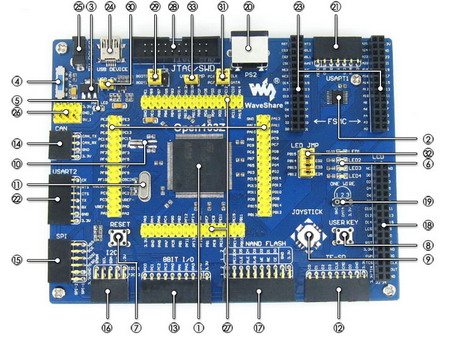
1. STM32F103ZET6: the high performance STM32 MCU in LQFP144 package which features
- Core: ARM Cortex-M3 32-bit RISC
- Operating Frequency: 72MHz, 1.25 DMIPS/MHz
- Operating Voltage: 2-3.6V
- I/Os: 112
- Memories: 512K Flash, 64K RAM (the highest specification in STM32F103Z series);
- Communication Interfaces: 3xSPI, 5xUSART, 2xI2S, 2xI2C, 1xFSMC, 1xLCD, 1xSDIO, 1xUSB, 1xCAN;
- AD & DA converters: 3xAD (12bit, 1μs, shares 16 channels); 2xDA (12bit);
- Debugging/Programming: supports JTAG/SWD (serial wire debug) interfaces, supports IAP
2. 74LVC139: for FSMC expansion, makes it possible to connect multi peripherals through FSMC at the same time, such as connecting a LCD and a NAND FLASH;
3. AMS1117-3.3: 3.3V voltage regulator
4. Power supply switch: 5V DC or USB
5. Power indicator;
6. LEDs: Convenient for indicating I/O status or program running state
7. Reset button;
8. User key;
9. Joystick: Convenient for I/O input (five positions)
10. 32.768K crystal oscillator: for internal RTC
11. 8M crystal oscillator: enables the MCU run at 72M frequency by frequency multiplication;
12. SDIO Interface: connects to the Micro SD Board easily, It is much faster to read/write the Micro SD card via SDIO than via SPI;
13. 8 I/O Interface: easily connects to keypad, motor, etc.;
14. CAN Interface: communicates with accessory boards which feature the CAN device conveniently;
15. SPI Interface: easily connects to SPI peripherals such as FLASH (AT45DBxx), SD card, MP3, etc.;
16. I2C Interface: easily connects to I2C peripherals such as I/O expander(PCF8574), EEPROM (AT24Cxx), etc;
17. NAND FLASH Interface: easily connects to the NAND FLASH peripherals;
18. LCD Interface: easily connects to the touch screen LCD;
19. ONE-WIRE Interface: easily connects to ONE-WIRE devices (TO-92 package), such as temperature sensor (DS18B20), electronic registration number (DS2401), etc.
20. PS/2 Interface: easily connects to PS/2 keyboard or mouse;
21. USART1 Interface: easily connects to RS232, RS485, USB TO 232;
22. USART2 Interface: easily connects to RS232, RS485, USB TO 232;
23. USB Port: USB communication between board and PC;
24. 5V DC jack;
25. 5V/3.3 V power input/output;
26. MCU pins connector: all the MCU pins are accessible on expansion connectors for further expansion
27. JTAG/SWD interface: for debugging/programming
28. Boot Mode Selection: for configuring the BOOT0 and BOOT1 pins
29. USB OTG Selection Jumper
- Short the jumper to enable USB OTG, connects to MCU I/O
- Open the jumper to disable USB OTG, disconnects from MCU I/O
30. PS/2 Interface Jumper
- Short the jumper to connect the PS/2 device to default I/Os
- Open the jumper to connect the PS/2 device to custom I/Os via jumper wires
31. LEDs Jumper
- Short the jumper to connect the LEDs to default I/Os
- Open the jumper to connect the LEDs to custom I/Os via jumper wires
32. VBAT Selection Jumper
- Short the jumper to use system power supply
- Open the jumper to make it possible to connect the VBAT to external power, such as battery
Photos
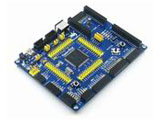
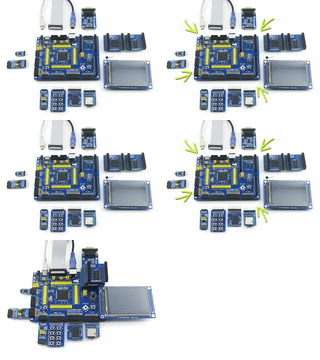
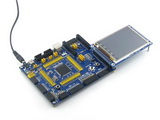
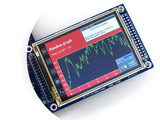
Open103Z Development Board Connecting to various peripherals Connecting to touch screen LCD Open107V μC/OS-II
Note:
The Open103Z supports programming via STM32 USART bootloader, a USB TO UART accessory board is also provided in the package.
The Open103Z does NOT integrate any debugging function, a debugger is required.
The Open103Z Standard includes only ONE accessory board -- PL2303 USB UART Board (mini).
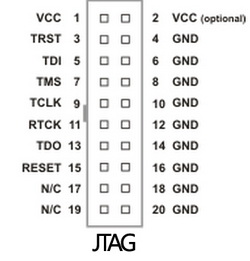
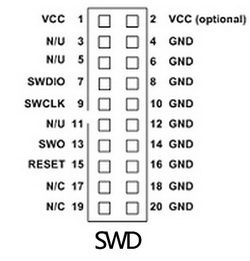
JTAG/SWD Interfaces
The figure 1, and 2 show the header pinouts of JTAG/SWD interface
Figure 1. JTAG Header Pinout Figure 2. SWD Header Pinout
Development Resources
The User Guide CD includes development resources listed as follow:
- Related softwares (KEIL etc.)
- Demo Code (examples in C, μC/OS-II)
- Schematic (PDF)
- STM32 Development documents (Datasheet etc.)
Package Contains
1. Open103Z development board x 1
2. PL2303 USB UART Board (mini) x 1
3. USB type A plug to mini-B plug cable x 1
4. USB type A receptacle to mini-B plug cable x 1
5. 4-pin wire x 2
6. 2-pin wire x 2
7. 5V Power Adapter x 1
8. User Guide CD(EN) x 1
Resources

 Popular products